This resource is for both Educators and Repair Advocates.
A consistently successful model for bringing teaching about repair into schools combines classroom instruction with school-hosted community repair events. This model harnesses the energy and resources of community repair event volunteers to advance educators’ objectives, and uses the openings offered by the classroom to advance repair advocates’ objectives. This approach is accomplished effectively through pairing in-class instruction about repair with an event owned and led by educators, with both instruction and event supported by community repair advocates.
“Repair advocates” are community members enthusiastic about repair, typically volunteers from Repair Cafés, Fixit Clinics, Restart Parties, and related repair events.
This resource is about in-class instruction, supported by repair advocates.
For a resource on repair advocates supporting school-hosted community repair events, go HERE.
Repair Offers Rich Teaching Opportunities in the Classroom
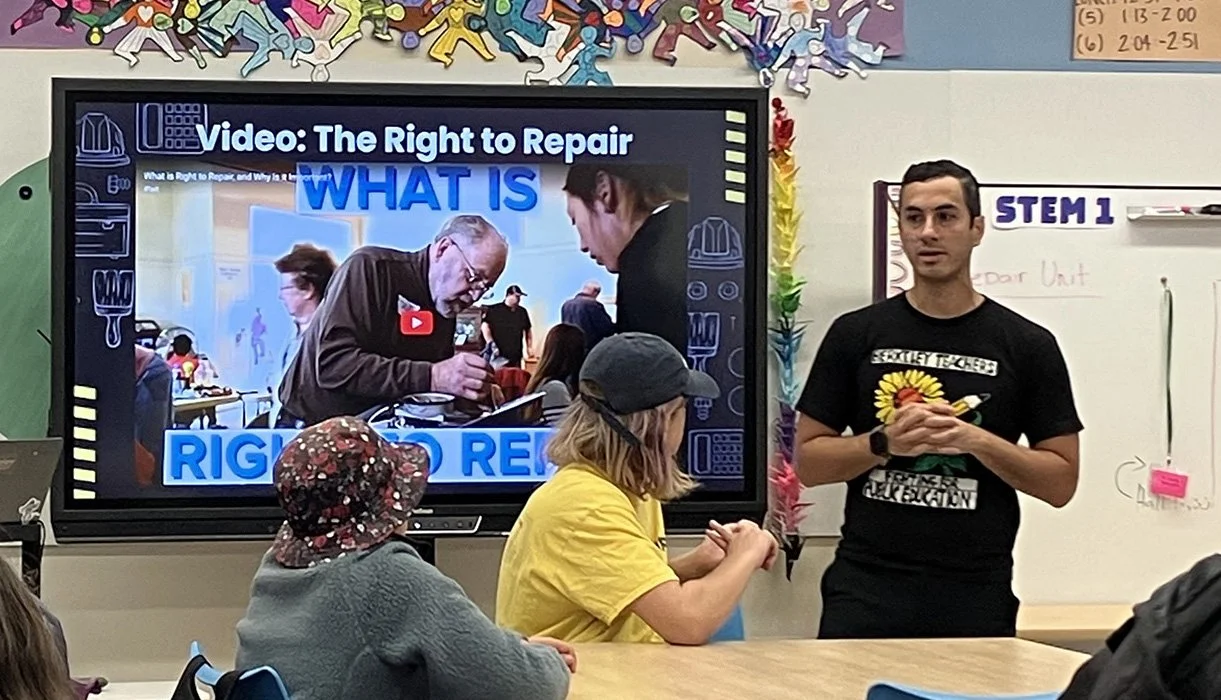
Steven Rivera teaching the week-long repair unit in MakerSpace class at Willard Middle School, Berkeley Unified School District, California USA
Teaching about repair can expand the scope of what’s already being taught, develop new ways of approaching and considering topics, advance thinking and fine motor skills, and link learning across subjects, and to students’ lives.
In hands-on fixing, students approach what's broken, dig into and understand what it’s made of, explore how it works, and find something not seen before — an opening of possibility — identifying a point and mode of intervention, and putting the broken object into working order.
Repair becomes an experiential model for approaching and engaging with problems — material, conceptual or social, small to large scale — and education becomes relevant, rooted, rigorous, and restorative.
Repair involves a wide range of thinking skills, draws from multiple subjects central to the goals of education, and supports developing a repair mindset grounded in care [See Note 1 below]:
Hands-on Skills
Tool use, technical literacy, design and engineering practices, applied learning
Critical Thinking Skills
Problem-solving, design thinking, creativity, systems thinking
Personal Development
Resilience, collaboration and adaptability, civic responsibility, agency
Across Subjects
Physics, math, chemistry, information technology, engineering, design, ecology, civics, and more
Educators’ objectives in Makerspace / STEM / CTE classes, and in environmental literacy programs, are particularly well-aligned with repair’s educational possibilities. Those classes and programs are therefore particularly promising points of entry for bringing repair into schools.
-
Repairing broken objects invites learning a wide range of cognitive skills -- problem-solving, resourcefulness; technical skills -- fine motor, soldering, sewing, 3-D printing, woodworking, etc.; and technical knowledge -- materials and processes.
Taking apart and repairing broken objects calls on and deploys learning from other classes into students' real lives -- electromagnetism, complete circuits, calculating area and volume, converting measuring units... Working on objects students are interested in places the hook for pursuing STEM and design education and advanced training, for engineering, design, and related vocations.
-
Putting objects back into working order and extending their useful lives makes abstract environmental and climate concepts concrete, personally relevant, and actionable.
Presenting repair contextually creates space for teaching about the environmental impact of the usually invisible ends of the supply chain — resource extraction and unregulated manufacturing on the one end, and an explosion of toxic waste in developing countries on the other.
An ecological understanding of impacts brings those remote phenomena into students’ lives.
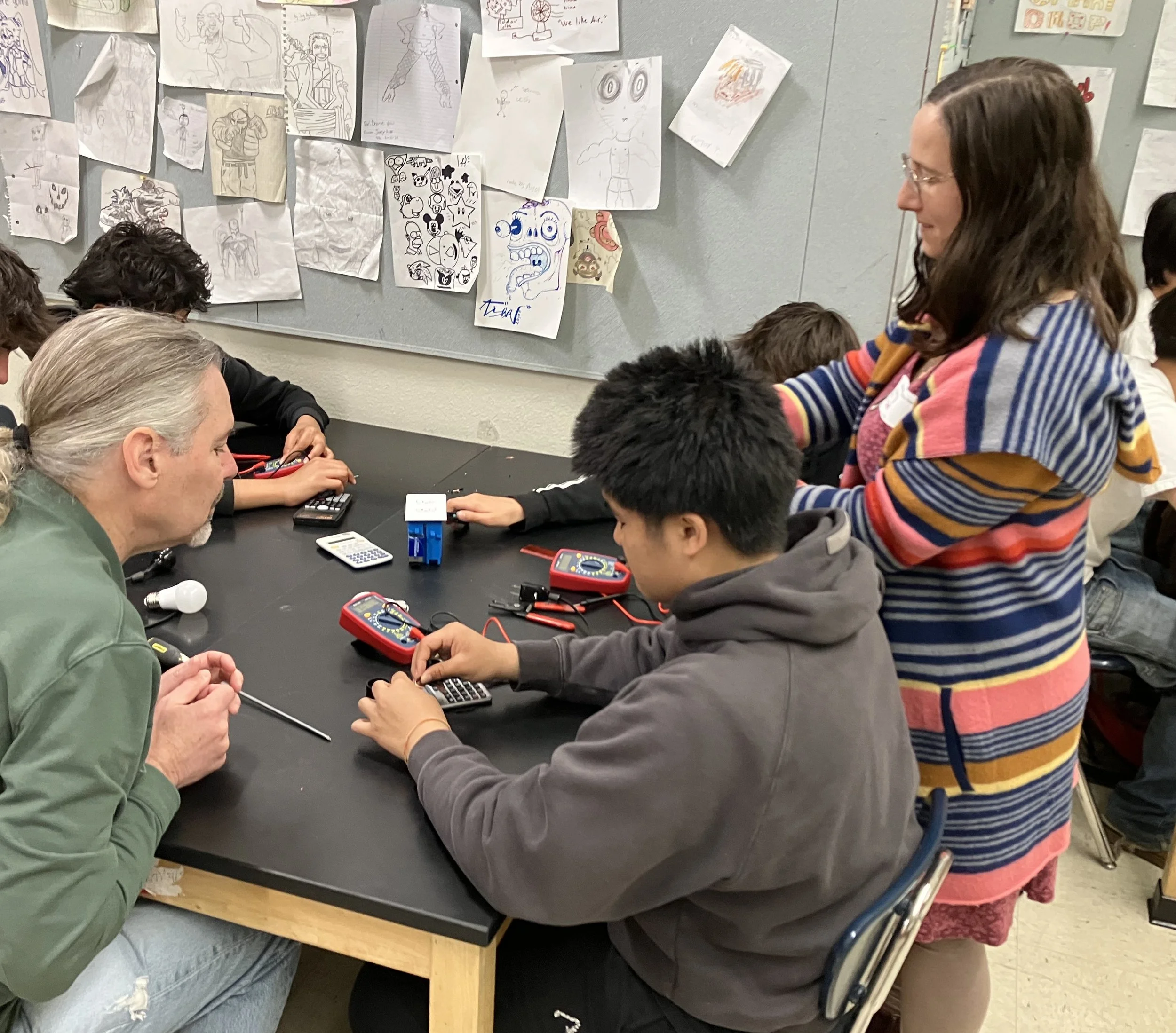
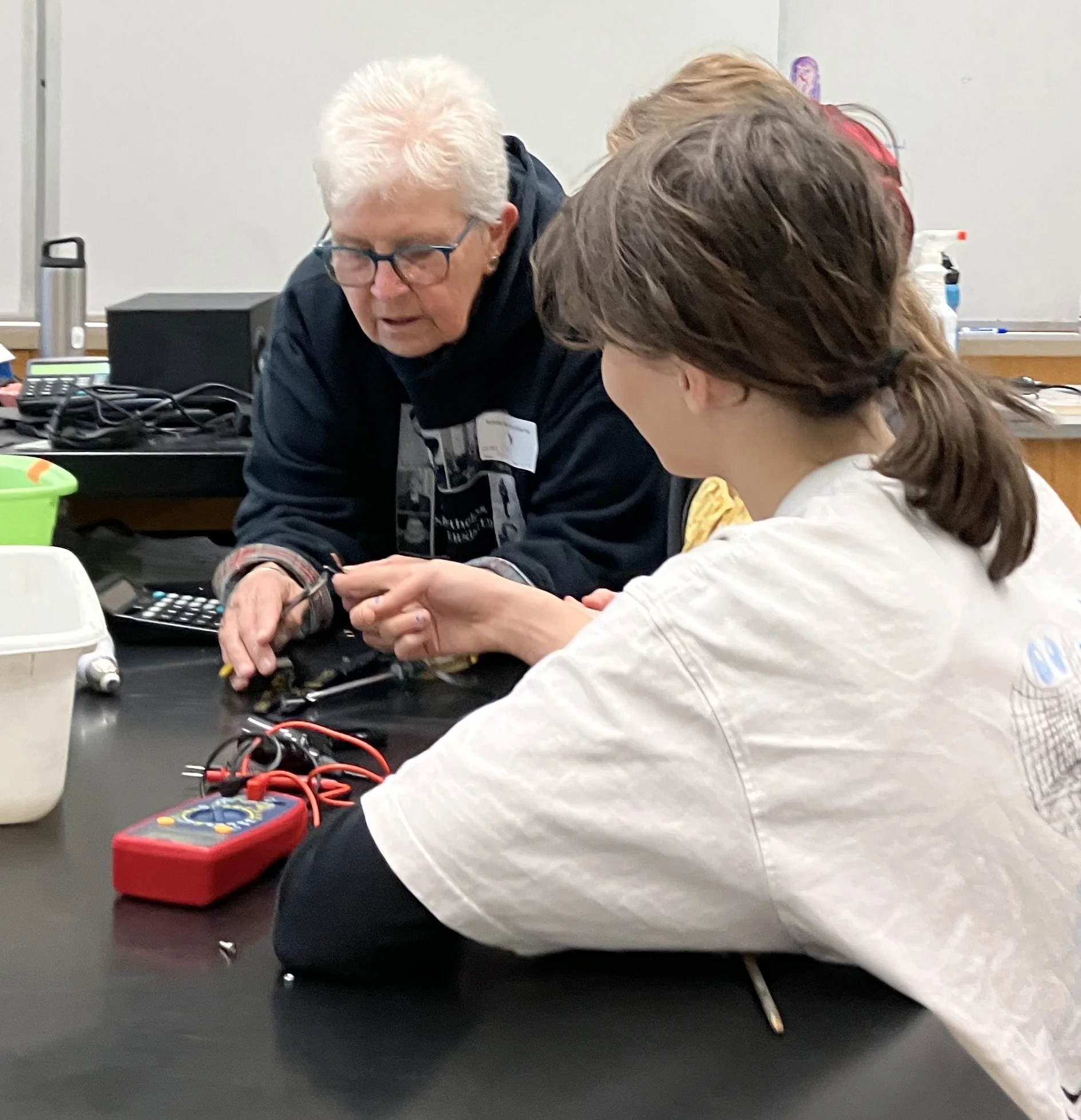
Nimble Repair’s Kimberley Schroder and a community volunteer teaching lamp repair in a week-long in-class repair until.
The Classroom Offers Unparalleled Opportunities for Advancing a Repair Culture
Cindy Navarro teaching lamp repair at Berkeley High School’s Sustainability Day Workshop. Berkeley Unified School District, California USA. (Note: the lamp repair kit and curriculum were developed by repair advocates.)
Bringing repair into the classroom:
Extends the visibility of repair into the community far beyond the reach of community repair events
Strengthens and legitimizes the repair message through the authority lent by the school’s authority
Shapes young minds
Reaches across generations
Objectives and Obstacles:
Solutions Through Collaboration
Educators
You want to enrich your teaching through exploiting the educational opportunities offered by repair.
You need:
Teaching resources: curriculum, lesson plans, activity sheets, etc.
Models for implementation
Technical know-how
Information about the larger economic, political and social repair context — e.g., Right to Repair, supply chain, etc.
Additional adults in the classroom for a meaningful hands-on educational experience
You have:
Students!
Classroom learning scaffolding and the larger educational context
Access to administrative and intramural systems and resources
Repair Advocates
You want to expand the range and impact of the repair movement.
You need:
Access to established classes and programs
Positioning repair productively in the larger educational project
The endorsement of schools’ administration
You have:
Technical expertise
Volunteers — additional adults in the classroom
Teaching resources — Educator Resource Library
Models for implementation — Notes from the Field
Enthusiasm and energy
A repair mindset and familiarity with the benefits of repair
Educators + Repair Advocates = Impact
In-class instruction combined with school-hosted community repair events, both robustly supported by local repair advocates, turbocharges both learning and developing a community-wide culture of repair.
-
Capture the highest level school authorization of the initiative as possible. Ideally, either the school board / board of trustees, or school district administration.
Integrate subject content from core curriculum classes into lessons:
Physics (e.g., electromagnatism)
Math (e.g., calculating area and volume)
Chemistry (e.g., the adhesive characteristics of various glue alternatives)
Ecology (the effect on eco-systems of e-waste leakage)
Civics (right to repair legislative processes and policies)
-
See “Cultivating a Repair Mindset” for research about, discussion of and tools for applying the triadic disposition model of learning to repairing broken objects. Research and tool development by teachers in the classroom, a legacy project of a pilot program of Project Zero, a research arm of Harvard Graduate School of Education.
“A theory of good thinking based on the concept of dispositions is proposed here. Dispositions are often considered to be a matter of motivation. However, defined here is an expanded concept called triadic dispositions which emphasizes (a) inclinations, which may reflect motivation, habit, policy, or other factors; (b) sensitivity to occasion; and (c) abilities themselves.”
(Citation at “Cultivating a Repair Mindset”.)
-
Note by Debbie Lenz, Berkeley Unified School District middle school STEM / MakerSpace teacher
Note by Ellen McClure, district-wide Climate Literacy Initiative coordinator, Berkeley Unified School District
Note by Kimberley Schroder, repair advocate teaching lamp repair in the classroom